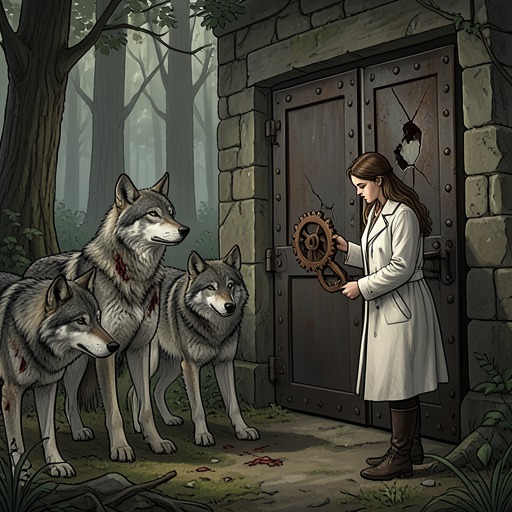
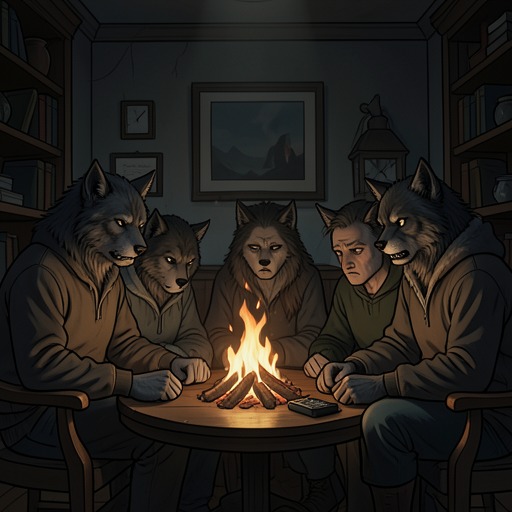
The werewolves' fertility and population crisis
Insatiable Box Set: Books 1-4The werewolves' fertility and population crisis turns reproduction into a question of survival, leadership, and who gets to decide the future of a pack. Faced with dwindling numbers and widespread sterility among Werefemales, Wilder tries to preserve his clan without resorting to the kidnapping of human women. His proposed solution—a single fertile human mate for himself and his brothers—offers a way to keep the Samsa family together, but makes Adrienne’s autonomy the point at which their survival strategy is tested.
Origins and Demographic Pressure
Wilder and his brothers inherit a crisis shaped by an earlier period of human persecution. Their parents sent the triplets to a cave rendezvous site to keep them safe; as the pups grew, their father taught them to hunt. Because humans hunted wolves, the werewolf packs dispersed across the United States and kept their numbers small to conceal their nature. That history links the population problem to secrecy: remaining hidden has protected the clans, but has also constrained how openly they can gather and reproduce.
For Wilder, the danger is not simply that his own family might have no children. Most Werefemales are described as sterile, and a compatible mate must also accept his brothers. The three Alpha triplets have pledged to stay together and jointly control the territory inherited from their father; none is willing to expel or destroy another to establish a separate household. Wilder therefore imagines one fertile woman bearing the brothers’ pups, rather than three separate women whose presence could expose the family’s secret.
Wilder’s Proposed Solution
Wilder establishes a council to consider the clan’s declining ability to breed. His response is deliberately different from capturing human females: he will not begin a campaign that might provoke humans to discover and destroy the werewolves. Instead, the brothers use their wealth and attractiveness to invite women to meet them. Earlier parties and interviews bring interested women, but Wilder rejects the candidates he considers unsuitable. He is looking for both fertility and a partner whose choice will allow the brothers to remain together.
The plan contains its own contradiction. It presents a human woman as the means of saving a people, yet gives the brothers’ demographic need considerable power over her expected role. Wilder’s rule that a woman may leave if she does not want all three brothers offers an acknowledged limit, but the pups of any brother she mates with would remain with the pack. The arrangement therefore joins a promise of departure to a claim over the children, placing personal choice inside a larger reproductive program.
Wilder’s urgency is personal as well as political. During the winter, he tells Adrienne that she is the only female nearby and that he will soon have to mate. Later, Drayton warns that Adrienne’s scent is difficult for Lycell to resist, while saying he himself can control his urges. The brothers’ different responses show that the crisis is not an abstract council matter: it intrudes into their conduct toward the woman on whom their plan depends.
Adrienne and the Limits of the Plan
Lycell’s behavior makes the danger in that dependence explicit. He threatens to take Adrienne against her will and send her away, expecting that she would return with a pup whom human society would not accept. His threat turns the language of population survival into a possible justification for sexual coercion. It also sharpens the contrast with Wilder’s stated refusal to capture women: a policy against kidnapping does not, by itself, prevent coercive treatment within the household.
Adrienne answers by asserting that her name is Adrienne Ward and demanding an apology for being addressed merely as a female. She also demands marriage, then specifies that she wants to marry Wilder, Lycell, and Drayton. Her decision brings the brothers’ shared arrangement into a form she actively names, rather than leaving her position as an unspoken consequence of Wilder’s selection. It does not erase the reproductive pressures surrounding the marriage, but it changes the terms on which she enters it.
This distinction matters to the crisis’s human cost. The plan depends on treating fertility as essential to pack survival, while Adrienne insists on being recognized as a person with a name and a say in her relationships. Her demand exposes the difference between being selected as a solution and choosing a family. The brothers’ success in keeping their clan together cannot be separated from that difference.
Rival Responses and Political Marriage
Bane articulates the opposing response to declining numbers. He argues that the Samsa brothers’ rules against killing humans and kidnapping human females have prevented his pack from reproducing and have effectively sentenced it to extinction. He proposes keeping Adrienne as a fertile female after destroying the Samsa brothers, and speaks of using her to produce pups for his pack. His position frames coercive reproduction as a remedy for demographic decline; the contrast makes clear that the crisis fuels conflict between competing systems of pack survival, not merely disagreement within the Samsa family.
The same pressure later extends to alliances between packs. Wilder tells Drayton that he must mate with Mena, explaining that the decision is meant to prevent war because the Samsa family is not strong enough to face the Alaska and Oregon packs. Drayton objects that he does not love Mena, while Wilder treats the proposed union as a political necessity. Here, reproduction and marriage become instruments of diplomacy as well as population growth, and the individual relationship is subordinated to the danger of inter-pack conflict.
That proposed match is not the only possible outcome. Wilder recognizes Mena’s love for Robert and sanctions their marriage, offering Robert continued work as the family doctor. Mena’s own perspective distinguishes human women from Werefemales, whose lives are described as serving pack males and whose standing depends on bearing pups. She had been subject to her father’s authority over whom she would marry, but her relationship with Robert gives her a different position. The contrast shows that the crisis can organize women’s lives around reproductive value, while individual choice can also redirect the alliances meant to manage it.
Significance
The crisis binds together secrecy, family unity, sexual authority, and the prospect of war. Wilder seeks a path to survival that avoids forcibly taking human women, yet his plan still asks one woman to carry the future of three brothers and a dwindling clan. Lycell’s threat and Bane’s explicit reproductive violence reveal how easily demographic necessity can be used to override consent; Adrienne’s demands and Mena’s marriage to Robert provide counterexamples in which women’s decisions reshape the arrangement.
Rather than offering a simple solution to sterility, the narrative makes population survival a continuing negotiation over kinship and power. The Samsa brothers’ unity depends on shared reproduction, while their alliances depend on marriages and pack politics. Against those collective claims, Adrienne’s insistence on her name and chosen husbands, and Mena’s choice of Robert, make visible the people whom a population strategy risks reducing to their capacity to bear children.